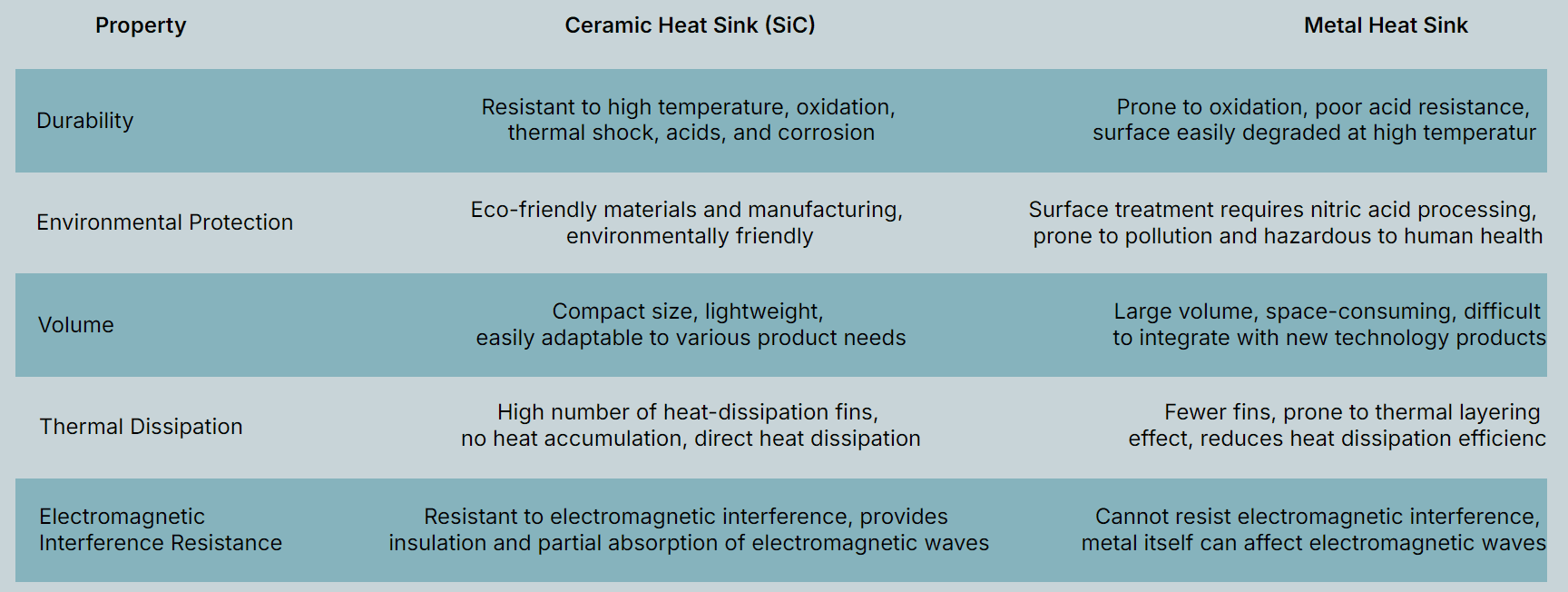
Property
Al–50% SiC
Al–63% SiC
Density (g/cm³)
2.75
2.9
Coefficient of Thermal Expansion
(ppm/°C)
7.5 @ 100°C
8.9 @ 150°C
6.5 @ 100°C
7.0 @ 150°C
Thermal Conductivity
(W/m·K)
178
180
Flexural Strength
(MPa)
334
378
Young’s Modulus
(GPa)
210
188
Specific Heat
(J/g·°C)
0.741
0.741
Advantages of Al-SiC Materials:
① Capable of mass production
② Adjustable coefficient of thermal expansion (depending on the ratio of aluminum to silicon carbide)
③ Resistant to thermal fatigue and degradation
④ Manufacturable in various shapes
⑤ Product surface can be electroplated or coated with thermal dissipation or insulating materials
Advantages of Al-SiC Materials:
① Capable of mass production
② Adjustable coefficient of thermal expansion
(depending on the ratio of aluminum to silicon carbide)
③ Resistant to thermal fatigue and degradation
④ Manufacturable in various shapes
⑤ Product surface can be electroplated or coated
with thermal dissipation or insulating materials
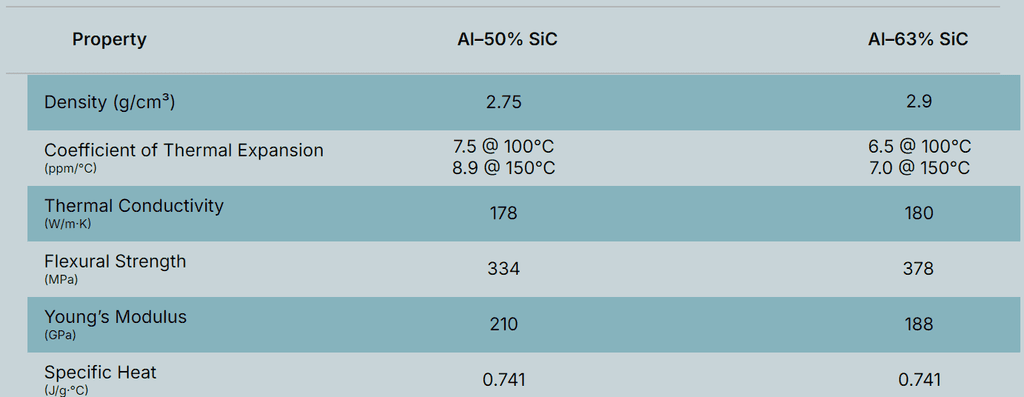
Material
Composition
Density
(g/cm³)
Young’s Modulus
(GPa)
Thermal Conductivity
(W/m·K)
CTE
(ppm/K)
Al-SiC
37%Al+63%SiC
Al
>99%
Al
6061
SiC
多孔
AlN
>99%
Cu
>99%
2.9
2.7
2.7
1.9
3.3
8.9
188
23
26
48
345
44
180
237
160
7
180
400
7
25
25
4.1
4.5
17
③ Lightweight Al-SiC can be applied in thermal management of electronic components, automotive industry,
high-precision machinery, green energy systems, and aerospace components..
① Al-SiC is structured with low thermal expansion coefficient (CTE) SiC and metallic aluminum with excellent thermal conductivity.
SiC provides heat dissipation, while Al ensures efficient heat transfer. Together, they deliver stable performance in conduction,
convection, and radiation, achieving superior thermal management.
② Within Al-SiC, the covalently bonded ceramic particles contribute to a high Young’s modulus.
Its wear resistance and mechanical toughness are also key advantages (flexural strength: 378 MPa).
② Within Al-SiC, the covalently bonded ceramic particles
contribute to a high Young’s modulus.
Its wear resistance and mechanical toughness are also
key advantages (flexural strength: 378 MPa).
③ Lightweight Al-SiC can be applied in
thermal management of electronic components,
automotive industry, high-precision machinery,
green energy systems, and aerospace components..
① Al-SiC is structured with low thermal expansion
coefficient (CTE) SiC and metallic aluminum with
excellent thermal conductivity.
SiC provides heat dissipation, while Al ensures
efficient heat transfer. Together, they deliver stable
performance in conduction, convection, and radiation,
achieving superior thermal management.
Material Characteristics
Material Characteristics
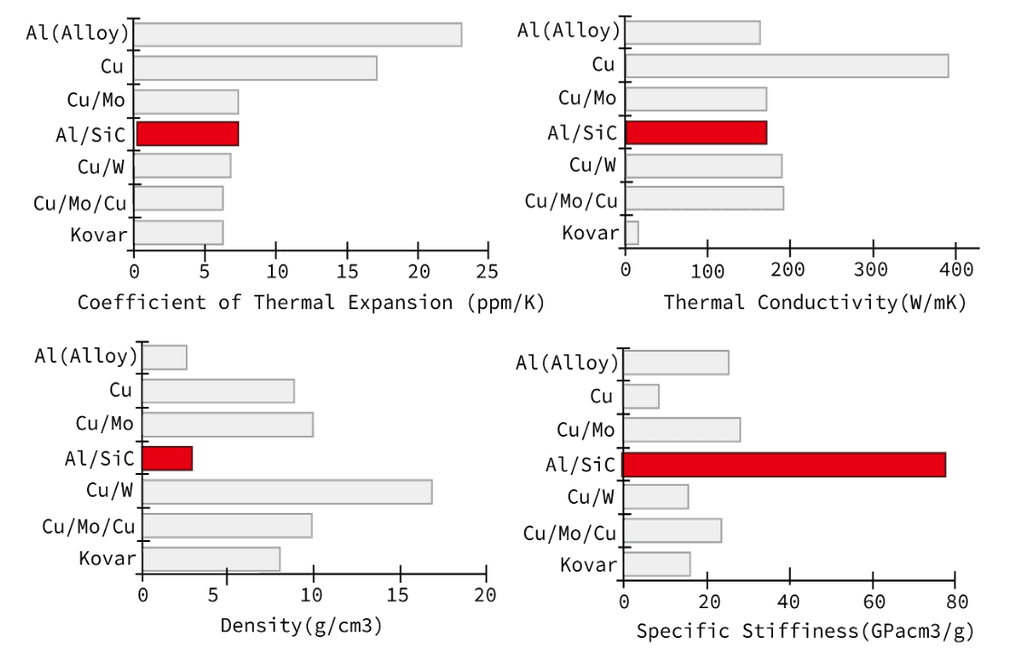
Material Comparisons
Research on Various Thermal Baseplate Materials
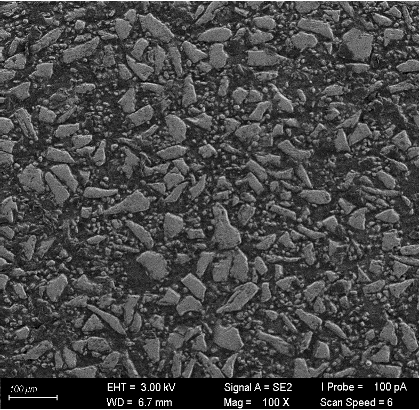
Al-SiC Cross-Section Metallographic Structure
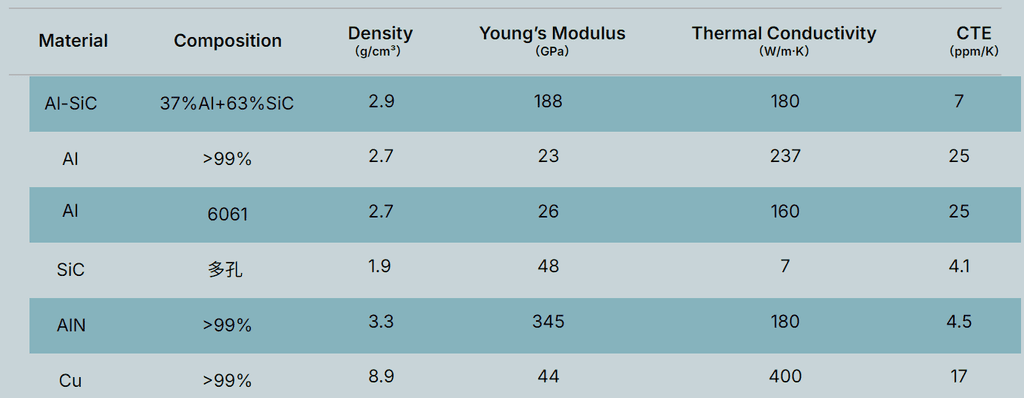
Property
Ceramic Heat Sink (SiC)
Metal Heat Sink
Durability
Resistant to high temperature, oxidation,
thermal shock, acids, and corrosion
Prone to oxidation, poor acid resistance,
surface easily degraded at high temperatur
Environmental Protection
Eco-friendly materials and manufacturing,
environmentally friendly
Surface treatment requires nitric acid processing,
prone to pollution and hazardous to human health
Compact size, lightweight,
easily adaptable to various product needs
Volume
Large volume, space-consuming, difficult
to integrate with new technology products
Thermal Dissipation
High number of heat-dissipation fins,
no heat accumulation, direct heat dissipation
Fewer fins, prone to thermal layering
effect, reduces heat dissipation efficienc
Resistant to electromagnetic interference, provides
insulation and partial absorption of electromagnetic waves
Electromagnetic
Interference Resistance
Cannot resist electromagnetic interference,
metal itself can affect electromagnetic waves
Comparison of SiC Ceramic Heat Sinks and Metal Heat Sinks
Comparison of SiC Ceramic Heat Sinks
and Metal Heat Sinks
Electromagnetic Interference Resistance

Research on Various Thermal Baseplate Materials
Al-SiC Cross-Section Metallographic Structure